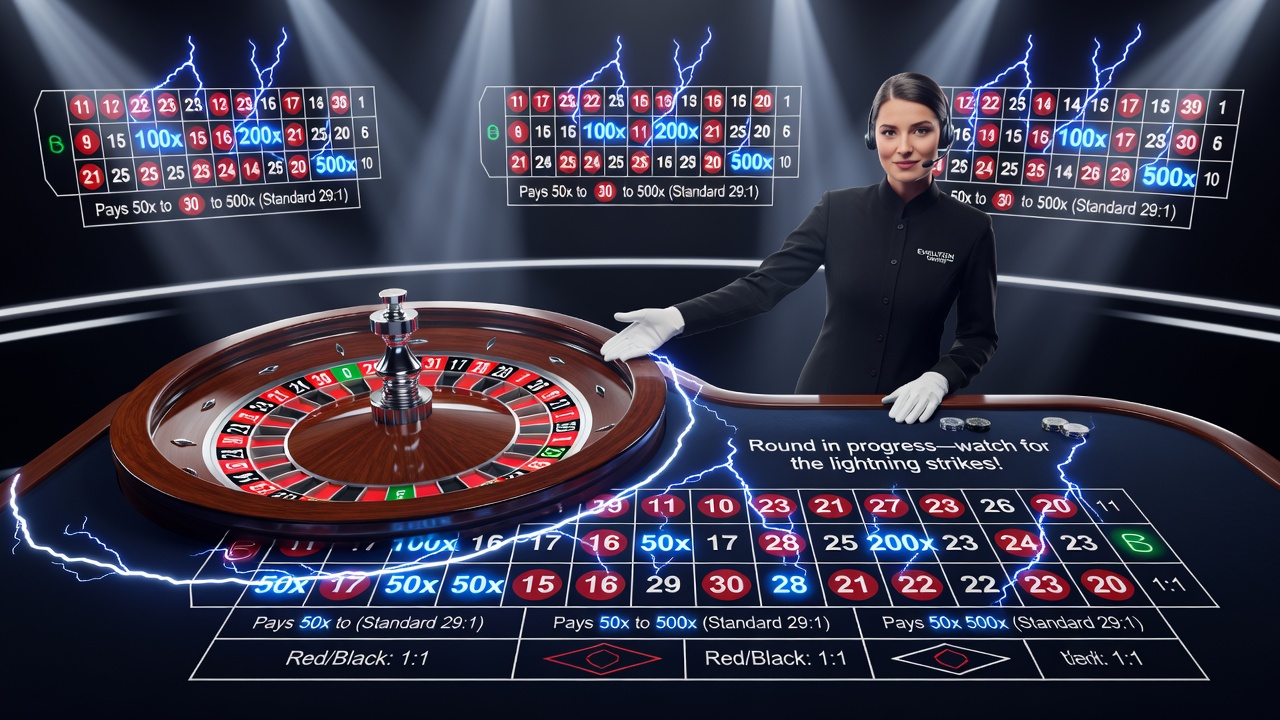
A single straight-up bet on European roulette pays 35 to 1. In Lightning Roulette, that same bet on a lucky number can pay up to 500 to 1. That difference isn't a typo or a marketing trick - it's the mathematical core of a game that has reshaped how players think about risk, volatility, and the house edge in live casino roulette.
Developed by Evolution Gaming, Lightning Roulette took a familiar wheel and injected randomized multipliers into the mix, turning a game of near-static odds into something far more unpredictable from round to round. Players who've spent years grinding standard European roulette often find the shift disorienting at first - the payout structure rewards patience and number selection in ways traditional roulette never did. If you want to see the mechanics in action before committing real bankroll, you can learn more about how the multiplier rounds actually play out in a live setting. Understanding that visual and procedural difference matters, because Lightning Roulette isn't simply European roulette with better graphics - it's a distinct probability model wearing a familiar coat.
This piece breaks down what actually drives outcomes in Lightning Roulette: the real odds behind each bet type, how payouts shift when lightning numbers strike, what long-run statistics suggest about volatility, and the specific live-dealer rules that separate this variant from anything you'd find at a physical casino table.
Lightning Roulette runs on a standard single-zero European wheel with 37 pockets, numbered 0 through 36. The wheel and ball mechanics are identical to any European roulette table. What changes is what happens between spins: before each round, a random number generator (RNG) - separate from the physical wheel - selects between one and five "lucky numbers" and assigns each a multiplier ranging from 50x to 500x. This happens during the betting window, displayed on screen as electric strikes across the number grid.
In classic roulette, every number carries identical payout odds. Lightning Roulette breaks that symmetry deliberately. A straight-up bet on a number that gets struck by lightning pays dramatically more than the same bet on a number that doesn't. This asymmetry is the entire point of the variant - it converts a flat-probability game into one with occasional outsized payouts, at the cost of slightly reduced payouts on straight bets that don't land on a lucky number.
Because the lucky-number generation happens before the ball drops, rounds in Lightning Roulette tend to run slightly longer than standard live roulette. The dealer waits for the multiplier animation to complete before spinning. This pacing is a deliberate design choice, not a technical delay - it lets viewers see exactly which numbers are "hot" for that round before deciding on last-second bets.
The underlying wheel odds in Lightning Roulette match any European roulette wheel: a 1-in-37 chance for any single number, roughly 48.6% for red/black or odd/even, and so on. Lightning roulette odds diverge from these baseline figures only when a multiplier is attached to a specific number. The odds of hitting any particular straight-up number remain 1 in 37 per spin - the multiplier doesn't change probability, only payout size.
To fund the occasional 500x jackpot-style payout, Evolution reduced the standard straight-up payout from the usual 35 to 1 down to 29 to 1 on numbers not struck by lightning. This is the trade-off that defines the entire game: lower guaranteed payout on most straight bets in exchange for the chance at a massive multiplier hit.
Outside bets - red/black, odd/even, columns, dozens - are untouched by the lightning mechanic. Their odds and payouts mirror standard European roulette exactly. This matters for players building a lightning roulette strategy around bankroll preservation rather than chasing multipliers.
Each round, the RNG independently selects between one and five numbers on the grid and assigns multipliers ranging from 50x to 500x. Because this selection is fully independent of the wheel spin, it's mathematically possible - though rare - for the ball to land on a number that has no lucky multiplier attached at all, even if other numbers on the board were struck.
If your straight-up bet lands on a number that received a lightning strike, the payout is calculated by the assigned multiplier rather than the standard 29 to 1 rate. A 500x hit on a single-unit bet returns 500 units - a payout ceiling far beyond anything available in traditional roulette variants, including most progressive side bets.
If the winning number carries a multiplier but no player bet on it, that multiplier simply goes unused for the round. Lightning roulette payouts are only triggered when an actual bet coincides with a struck number - the multiplier itself doesn't create free winnings for anyone at the table.
Standard European roulette carries a house edge of approximately 2.7% across nearly all bet types. Lightning Roulette's house edge varies more by bet type: outside bets retain the familiar 2.7% figure, while straight-up bets on non-lightning numbers carry a higher house edge, closer to 19-20% when averaged across the reduced 29-to-1 payout structure. This is offset over many rounds by the occasional high-multiplier hit, but it means lightning roulette statistics favor outside and combination bets for players prioritizing consistency.
The 500x multiplier is deliberately rare - it appears far less often than the 50x or 100x tiers within the RNG's distribution. Players tracking session data typically see multipliers clustered toward the lower end of the range, with the top multiplier surfacing only occasionally across extended play. Treating the maximum multiplier as a realistic per-round expectation misreads how the distribution actually works.
Because straight-up bets combine a reduced base payout with an occasional outsized multiplier, session results in Lightning Roulette swing more widely than in standard roulette. A player betting only on numbers can experience long stretches with no multiplier hits followed by a single round that recoups the entire session. This volatility is why bankroll management carries more weight here than in flatter-odds games.
Live lightning roulette rules impose a fixed betting window per round, typically shorter than in some other live variants because of the added multiplier reveal step. Bets must be placed before the dealer initiates the spin, and the lucky-number animation displays before the window closes, giving players a final chance to react to which numbers are electrified.
Lightning Roulette supports the full range of standard roulette bets - straight-up, split, street, corner, line, column, dozen, and the outside bets. Minimum and maximum limits vary by operator, and some platforms cap straight-up bets differently from outside bets to manage the payout exposure created by high multipliers.
As with other Evolution-produced live games, dealers follow scripted call sequences - announcing "no more bets," confirming the winning number, and verifying multiplier payouts on-screen before disbursing winnings. Multiple camera angles typically show both the wheel and the multiplier grid simultaneously, allowing players to verify results without relying solely on the software's stated outcome.
The multiplier RNG operates independently of the physical wheel and is subject to the same regulatory testing standards applied to other live casino RNG systems. This separation is deliberate - it ensures the wheel's physical randomness isn't influenced by, or tied to, the software-generated lucky numbers.
A workable lightning roulette strategy usually blends a small number of straight-up bets - chasing multiplier value - with a base of outside bets that preserve bankroll odds closer to standard roulette. Betting exclusively on numbers concentrates risk around the reduced 29-to-1 payout and the rarity of high multipliers landing on a covered number.
Given the wider swings documented in lightning roulette statistics, sessions should be bankrolled with more cushion than flat-odds roulette. Setting a fixed loss limit and a target multiplier-hit goal, rather than chasing the 500x ceiling indefinitely, keeps sessions from spiraling based on emotional decision-making after a near-miss.
Some players track which numbers get struck across sessions, looking for patterns. Because the multiplier selection is independently randomized each round, past strikes carry no predictive weight on future rounds. Strategy should account for payout structure and bankroll discipline, not perceived patterns in an RNG that resets fully every spin.
No - the reduced 29-to-1 payout on non-lightning straight-up bets is a disclosed, structural trade-off that funds the higher multiplier payouts elsewhere in the game. It isn't a hidden penalty; it's published in the game's paytable and applies uniformly to every player at the table.
No. The lucky-number selection uses an independent RNG each round, with no connection to previous results or the physical wheel. Any pattern you notice across sessions is coincidental rather than predictive.
If your straight-up bet coincides with the 500x multiplier, your payout is 500 times your wager on that number. This ceiling only applies to straight-up bets - outside bets are capped at their standard 1-to-1 or similar payout regardless of multipliers in play.
Statistically, yes. Outside bets retain the standard 2.7% house edge of European roulette and aren't affected by the multiplier mechanic at all. Straight-up bets carry a higher house edge on average because of the reduced base payout, offset only occasionally by a multiplier hit.
Only the payout size. Every number still has exactly a 1-in-37 chance of being the winning number per spin, whether or not it carries a multiplier that round. The lightning mechanic changes what you win, not how likely you are to win it.
Between one and five numbers are randomly assigned multipliers each round, with values ranging from 50x to 500x. The exact count and value combination changes every round and has no bearing on subsequent spins.