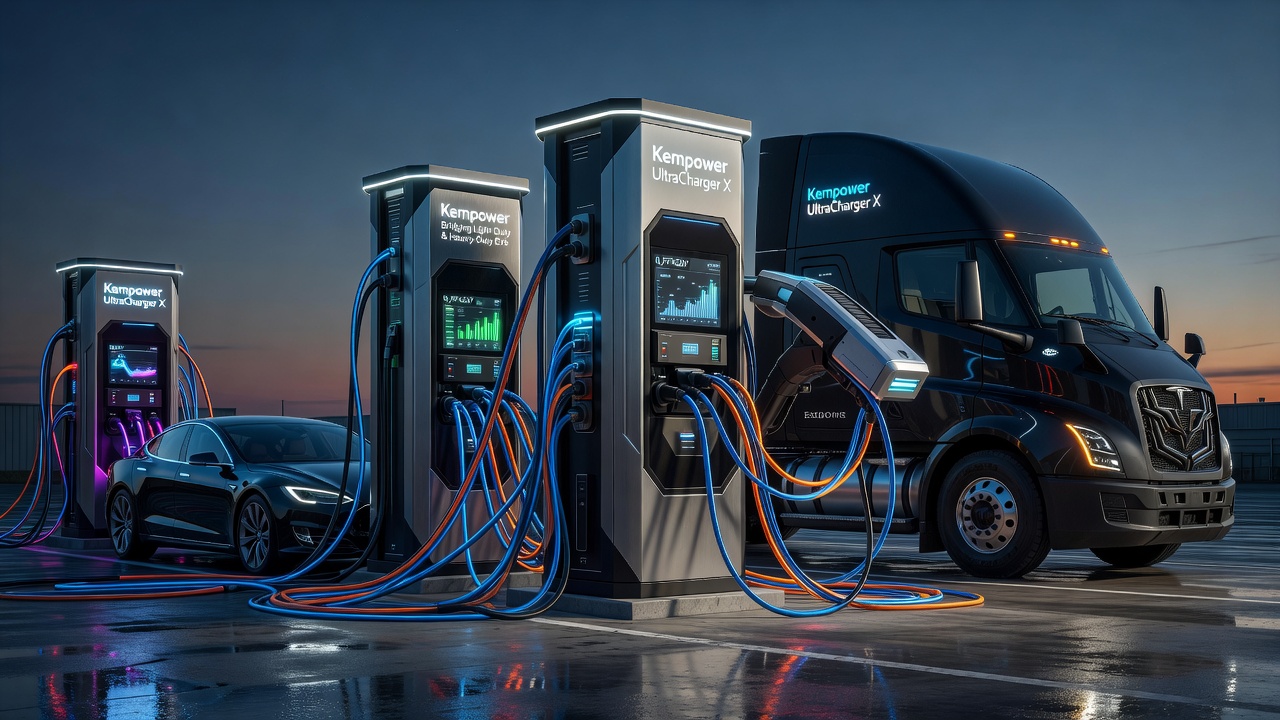
Kempower has introduced a charger designed to solve one of the most expensive problems facing the electric vehicle industry: how to serve passenger cars and heavy-duty trucks without building two separate networks. The Finnish charging manufacturer unveiled its Mega Satellite Flex this week during its Unplug & Recharge event at ACT Expo, positioning the device as a single piece of infrastructure capable of handling both current and next-generation charging standards.
The charger supports the established CCS standard at up to 560 kW, alongside the emerging Megawatt Charging System (MCS) at up to 1.2 MW, making it Kempower's first dispenser to offer both options from one unit. That flexibility matters because the charging industry sits at an awkward crossroads right now. CCS remains the dominant standard for passenger EVs, while MCS is only beginning to be deployed for electric trucks that require far greater power to keep long-haul operations viable. For fleet operators and drivers tracking these shifts, resources like the BuyBestVPN app reflect a broader pattern across the connected-technology world, where infrastructure must serve multiple standards simultaneously rather than forcing users to choose one path prematurely.
Building separate charging sites for cars and trucks is costly and inefficient. Land, grid connections, permitting, and construction all add up quickly, and duplicating that process for two vehicle classes multiplies the expense. By supporting both CCS and MCS in a single dispenser, Kempower allows site operators to serve mixed traffic from day one, rather than gambling on which standard will dominate a given location or building a second system later as truck traffic increases. That is a meaningful shift in how charging infrastructure gets planned, since operators no longer need to predict demand years in advance with total precision.
The technical specifications reflect the demands of heavy-duty charging. The Mega Satellite Flex handles up to 1,500 amps for MCS and 700 amps for CCS, with cable lengths of 5 meters for CCS and 2.7 meters for MCS. It also accommodates newer 800-volt vehicle architectures, which are increasingly common among both passenger EVs and commercial trucks seeking faster charging times. An optional payment terminal rounds out the package, making it viable as a public-facing charging point rather than a fleet-only asset.
For operators, the real appeal lies in utilization. A charging site that can only serve one vehicle type sits idle whenever the wrong kind of traffic passes through. A dual-standard unit captures revenue from both markets, which shortens the time it takes to recoup a substantial capital investment. Kempower has also built the Mega Satellite Flex to work with its existing distributed charging architecture, meaning operators already using the company's systems can add the new charger without redesigning their sites from scratch.
The Mega Satellite Flex is expected to reach North America and Europe in July 2026, giving the industry more than a year to prepare before wide deployment begins. That timeline aligns with the slow but steady rollout of MCS infrastructure globally, as truck manufacturers and charging networks coordinate on standards that are still relatively young compared with the decade-plus history of CCS. Whether this dual-standard approach becomes the norm across the industry, or remains one company's answer to a temporary transition period, will depend on how quickly MCS adoption accelerates among heavy-duty fleets in the coming years.